Yama – The Teacher at the Threshold
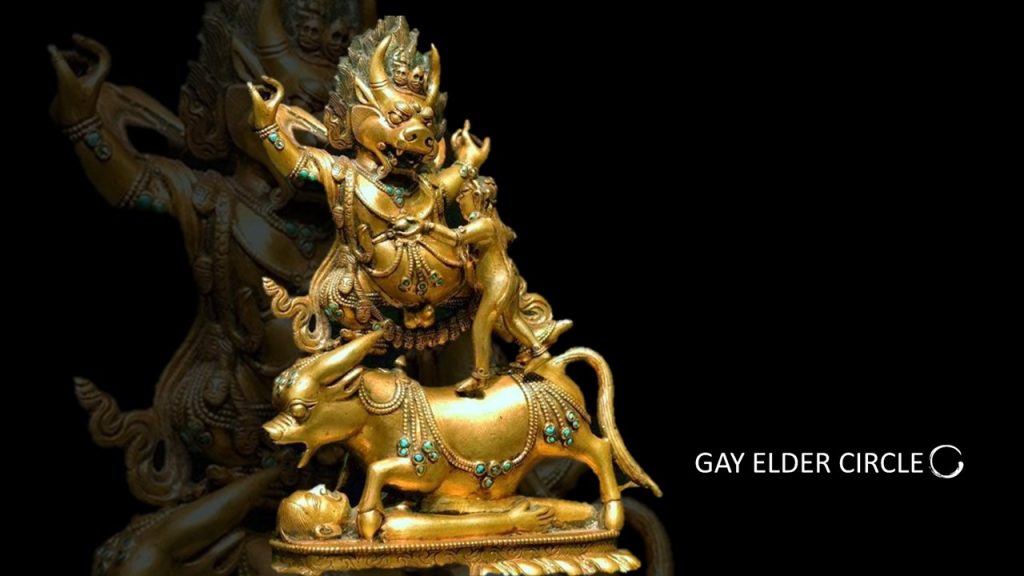
There are some things the old ones do not speak of too quickly. Death is one of them. They know that if you speak of death carelessly, you have not yet learned what death has come to teach.
In the old stories of India, there is a man called Yama. He is the Lord of Death, but that is only the beginning of his story. He is also the keeper of the road between this life and what lies beyond it, the one who waits at the threshold and remembers what human beings would rather forget: every life has a measure, every action leaves a footprint, and no one walks this earth without leaving something behind.
The young Nachiketa learned this. Though only a boy, there was an oldness in his question. Sent by his father to Yama’s dwelling, he waited three nights without food or welcome. When Yama returned, he found the boy patiently sitting at his door. Yama did not dismiss him because he was young. He listened. He offered Nachiketa the things most people spend their lives seeking—wealth, pleasure, long life, possessions, beautiful things. But Nachiketa had seen through them. He asked what happens when a person dies. He wanted what could not be taken away by death.
Yama tested him, and in that testing came a lesson that remains with us: the pleasant and the good are not always the same. The pleasant says, “Take this now.” The good says, “Wait. Look more deeply.” The pleasant asks what will satisfy the hunger of this moment; the good asks what kind of person we are becoming.
That is where Yama’s teaching reaches us. He is not simply keeper of the dead, but keeper of moral order. He stands where the consequences of our choices can no longer be hidden behind excuses. The old ones understood this. They would say that a person does not walk alone. Behind every person walks what that person has done. A harsh word walks behind us. A kindness walks behind us. A promise kept walks behind us. A promise broken walks behind us. We may outrun a witness, but we cannot easily escape the shape our actions have made within us.
This is not punishment for punishment’s sake. It is the deeper truth that our actions enter the world. What we do changes other people. What we say can wound or heal. What we tolerate becomes part of the community we leave behind. A people who practice cruelty should not be surprised when cruelty becomes familiar. A people who practice generosity discover that generosity can become a way of life. The seed remembers the tree.
Perhaps that is why October has something to teach us about Yama. The heat of summer gives way, the leaves turn, and then they let go. They do not ask whether falling is failure. They simply surrender to the season. Those of us who have lived long enough know that life has many Octobers. There comes a time when we must let something fall: an old anger, a wound, the need to be right, the pride that keeps us from saying we were wrong. The young may think letting go is weakness. The old know better. Some things can be carried only so long before they begin to carry us.
Yama stands beside that autumn tree and asks us to look honestly at the life we have been given. Whom did you help? Whom did you hurt? Where did you choose the pleasant road when you knew the good road was harder? Where did you remain silent when someone needed you to speak? And perhaps the hardest question: What are you becoming?
These are not questions for the dying. They are questions for the living. The great gift of remembering death is that it teaches us how to live. Nachiketa had the courage to ask what lies beneath fear, desire, pleasure, and sorrow. Perhaps every generation needs such a Nachiketa—and an elder like Yama, willing to say, “Sit down. Be still. You have been running long enough. Now look.”
So when October comes and the leaves begin their quiet descent, perhaps we should see an invitation. Sit for a while. Remember. Give thanks for what has been given. Tell the truth about what has been done. Ask forgiveness where it is needed. Offer forgiveness where the heart is ready. Then, like the leaves, release what no longer belongs in your hands.
Yama reminds us that life is precious not because it lasts forever, but because it does not. A day matters because it ends. A conversation matters because there may not be another. A hand matters because someday it will no longer be there to hold. Human dignity is found not in what we possess or how loudly we command, but in the way we walk among others while we are here. So walk gently. Speak truthfully. Do not mistake wealth for wisdom or comfort for goodness. When you have caused harm, have the courage to say so. When you have received kindness, remember it. When someone is sitting alone at the edge of the fire, make room.
The leaves fall. The seasons turn. Children become elders. The river continues toward the sea. And somewhere beyond our knowing, Yama waits—not as an enemy, but as the ancient keeper of a question we have carried all our lives: What did you do with the life that was given to you?
October comes each year to ask us that question while there is still time to answer.